Chapter 20
Decisions have gravity
Match commitment to reversal cost and the evidence waiting can produce.
On this page
There were four holes I had not drilled.
The progressive press mounts through four bolts. While the bench top was flat, drilling would have been easy. Assembled and crowded with equipment, the same work means a hand drill in an awkward corner. Every day of progress made the execution more annoying.
I still did not drill.
The position depended on information that was improving: where other equipment would settle, how the operator's body would meet the handle, whether the cabinet door cleared, and what surface the preparation flow required. Wrong holes would be expensive to reverse. Waiting was buying evidence faster than it was spending option value.
Then the evidence arrived. The rest of the bench layout had settled. I had exercised the neighboring tools and understood their operating envelopes. The mount landed four inches from the front edge and just under six inches from the side edge. I drilled the holes and bolted it down before the first physical case-processing cycle.
The work was trivial because the custom mount mediated the geometry and load. The press kept its own geometry. The bench only had to accept the mount's four-point contact. The mount made the commitment cheap to execute; it did not decide where the commitment belonged. This is a permanent installation, not a quick-change standard inferred from the hardware.
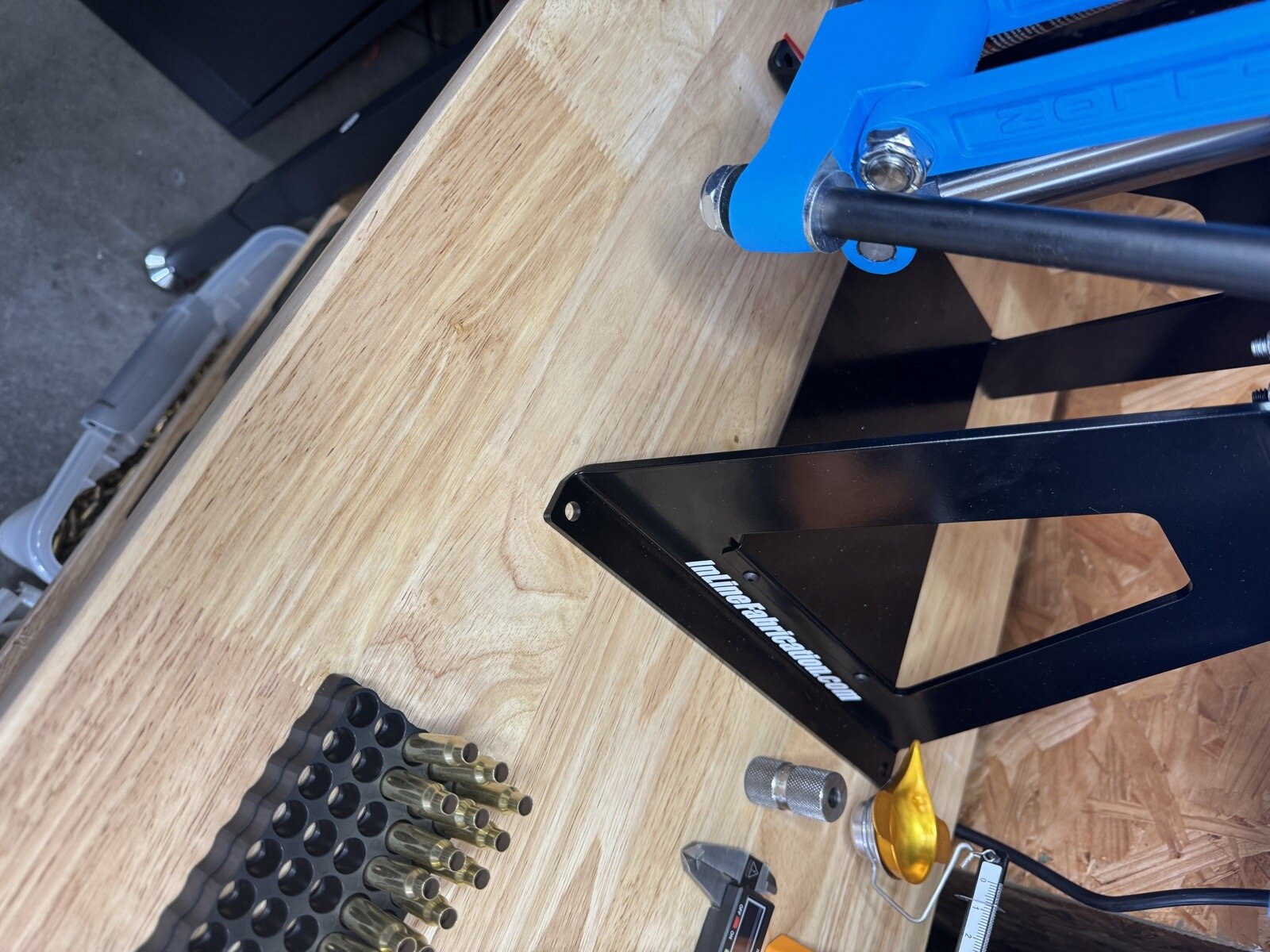
Deferred: the mount stayed movable while the layout and operating envelopes were still teaching.
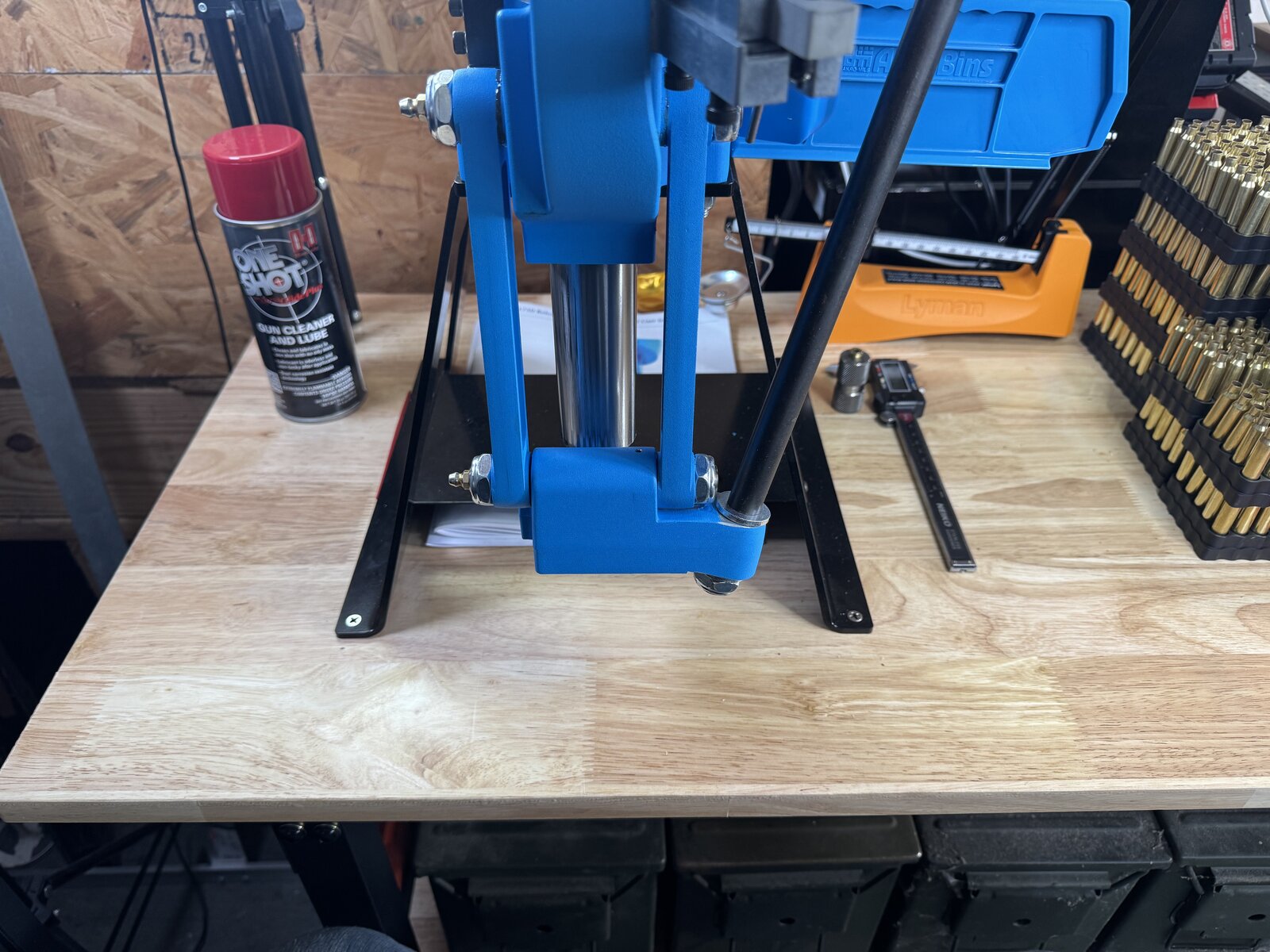
Committed: four inches from the front edge, just under six inches from the side, before physical case processing.
"I waited and it worked out" is not a method. The method begins with two questions.
Reversal cost and information gain
For any consequential decision, ask:
- How expensive is this decision to reverse?
- How much better will the available information become if I wait?
The answers produce three useful actions:
| Reversal | Information improves by waiting | Action |
|---|---|---|
| expensive | little | decide early and carefully |
| cheap | much | defer and let the system teach |
| expensive | much | build the cheapest faithful proof |
There is a fourth ordinary case: reversal cheap and waiting teaches little. Decide quickly. The decision does not deserve a ceremony.
Plan in proportion to the cost of being wrong, not in proportion to your ability to imagine the future.
Put the real decisions in the table
The garage decisions show the bins in practice. Three carry the chapter:
| Decision | Reversal cost | What waiting could teach | Action | Deferral closes when |
|---|---|---|---|---|
| Preserve parking and safe circulation | high if violated after build | little about whether the household needs it | decide now | continuous obligation, never deferred |
| Drill the press holes | high and visibly permanent | final neighbor positions and operator feel | defer actively, then commit | before first physical case-processing cycle; closed |
| Reserve unknown swager space | commitment premature; losing all space costly | actual footprint and reach | protect the option, then spend it | real tool positioned and exercised; closed |
Five more decisions ran the same bins; the full table, with evidence and counts, lives on The Lab Ledger.
Active deferral has a condition. Without the last column, "not yet" becomes a story told by unresolved work.
The red tray is a good example. It did not pretend to measure the swager. It made the unknown and its capacity cost visible while keeping the final answer open. Later the RCBS swager took a real position and worked the fifty-case commissioning set. The early reservation remains part of the story because it shows what was unknown before the tool closed it.
Active deferral also has a tempo limit. A night away from a hard tradeoff can be part of the loop rather than a gap in it; some decisions read differently after they settle. But incubation earns its place only while the cost of waiting stays low. The moment the answer blocks someone else, the pause has become avoidance.
Fits and works are different claims
Measurements showed that the proposed arrangement fit. They could not show what the room felt like in use: whether a door opened around a body, whether a handle's travel crossed a walkway, whether two people could share the space.
Because the commitment was costly and the missing information was learnable, the layout received a full-scale mockup. Real objects occupied the floor. The car, doors, bodies, and handles moved.
The proof could return no. Several pieces moved.
A proof that can only confirm the favored answer is a demonstration. A useful proof exposes the riskiest assumption at enough fidelity to reject the design. Choose the lowest rung that can answer the question:
- paper sketch for relationship errors;
- measurements for fit;
- cardboard or real-object mockup for reach and movement;
- one controlled physical operation for interaction;
- live use for demand, maintenance, and production behavior.
More fidelity costs more. Less fidelity may answer a smaller question. The right proof matches the unknown, not the seriousness with which the team can present it.
Architecture is the load-bearing subset
The body plan contains every part and connection. Architecture is the subset whose change redraws the creature or its long-lived contact surfaces.
Six reloading decisions currently carry that weight:
- The station occupies a bounded footprint and may not consume protected household capabilities.
- Case preparation owns the transition from recovered brass to material fit for production.
- Production consumes cases admitted at readiness and retains a safe veto on anomalies.
- Caliber-specific carriers preserve segregation downstream of classification.
- Observation and traceable records are system requirements, not private operator habits.
- The layout remains changeable while equipment and workflow are still being proven.
Change those and boxes, arrows, guarantees, or system boundaries move.
Exact bench coordinates, shelf heights, which press sits left, and the order of accessory installation can matter greatly without being architectural. They are local design decisions inside the intact drawing.
Importance does not make a decision load-bearing. The bench position felt enormous and changed by inches. The readiness guarantee feels like one line and holds the production body plan together.
Use three labels before changing code or hardware:
- Architectural move: changes a load-bearing boundary, persistence model, service contact, or long-lived public protocol.
- Local body-plan move: changes object boundaries, collaborators, ownership, or refusal lists inside one slice.
- DNA move: changes implementation without changing who talks to whom.
Labeling the move determines how much alignment and proof it deserves. It also stops a new collaborator or moved decision from hiding inside "cleanup."
The press that refused to retire
The small single-stage press was expected to disappear when the progressive press arrived. Early workflow evidence gave it another role. Military brass made decapping and primer-pocket preparation recurring work. Before the Dillon dies arrived and its case-processing configuration was understood, isolating decapping on the Lee avoided disturbing an unfinished machine.
The role emerged before the placement. Then the operation, not the category, chose the location: the small press needed the stiff center of a bench edge and an operator square to its long pull. "Presses belong together" was a taxonomy, not an operating argument.
The placement was doubted later as other tools arrived. It was re-evaluated against the current system and survived. A previously correct decision is not immune to changed evidence. A doubted decision is not automatically wrong. Both deserve the same current test.
The larger press lost center stage for the same reason. Its operating envelope worked offset to the left, leaving scarce edge surface for the preparation flow. Prestige did not own the center. Work did.
Then the evidence changed again. The Dillon case feeder and station-one die decapped and full-length sized volume 5.56 in one pass while capturing spent primers. The separate volume-decapping handoff stopped buying anything. The Lee kept its position but lost the primary job; it now serves fallback, diagnosis, experiments, and controlled single-stage work.
The first responsibility map was not foolish. It made progress possible under the evidence available then. Production later falsified its most absolute claim. Let production redesign the system returns to that correction after the complete flow has run.
Prepare, prove, produce
The decision loop has a name:
- Prepare: draw the system, identify the decision, expose the unknown, and state the trade.
- Prove: produce the missing evidence at the cheapest faithful level.
- Produce: commit, build, test, and ship the capability.
Prove is not passive waiting. Waiting belongs there only when time or use will produce the missing information and the option remains protected. The layout mockup, cabinet-door operation, baseline photograph, and controlled bench move were active proofs.
Not every epic needs a separate Prove phase. Architecture does. Local design needs a drawing and a test. Implementation can iterate in the inner loop. Choose discipline by level rather than applying one ceremony to every choice.
Sort one decision
Fill this table for a decision your work is approaching:
| Decision | Level | Cost of being wrong | Reversal cost | What waiting teaches | Cheapest proof | Possible no | Action | Due condition |
|---|---|---|---|---|---|---|---|---|
Then ask:
- Does changing it redraw the body plan or rearrange one part?
- Will information genuinely improve, or are you postponing contact with the system?
- Can the proof fail the preferred design?
- What option cost does deferral charge?
- What event closes the deferral?
Do not spend one hundred dollars of cognition to save five dollars of execution. Do not sell a one-hundred-dollar option to collect five dollars of visible progress either.
The limit of deferral
Waiting stops being prudent when it blocks downstream work, when later access will be much harder, when a cheap proof is available today, or when no new information will arrive.
The undrilled holes charged an execution cost. The full-scale layout consumed an afternoon. The reserved tray occupies useful surface. Options are purchased, not free.
The mounting decision stayed honest because it had a due condition: before physical case processing. Once the layout and operating envelopes stopped producing new information, the condition arrived. The mount was fixed and the press bolted down. If production had begun while the holes remained an excuse, deferral would have failed its own test.
The next chapter starts the material journey with the whole desired software behavior visible in a failing outer test. That is another cheap proof: make the organism attempt to walk before perfecting its parts.